
Since 1982, Reliability in
Every Batch
Precision Mixing for Advanced
Energy Storage Materials
Engineering the Foundation of Battery Performance
The electrode mixing process fundamentally determines battery cell performance. Reliance Mixers delivers the precision and repeatability required for both R&D development and high-volume production of battery materials using our advanced High Intensity Mixer technology.
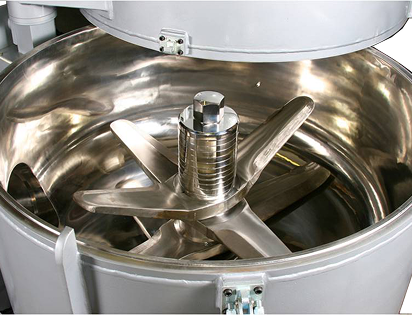
Critical Capabilities for Battery Applications
Electrode Slurry Preparation – Our High Intensity Mixer systems address the unique challenges of battery material processing:
Active Material Dispersion
- Uniform distribution of NMC, LFP, or NCA particles
- Complete wetting of carbon additives
- Controlled shear to prevent particle fracture
- Temperature management to preserve binder integrity
Process Control Features
- Multi-point temperature monitoring
- Variable speed operation from 100-3000 RPM
- Vacuum and inert atmosphere capabilities
- Data logging for quality documentation
Container Mixing for Flexible Production
Advantages for Battery Manufacturing:
- Eliminate cross-contamination between chemistries
- Rapid changeover between formulations
- Direct integration with coating lines
- Scalable from R&D (10L) to production (2000L)
Technical Specifications for Battery Applications
Download our comprehensive product PDFs to explore detailed features of our High Intensity Mixer.
Mixing Performance:
- Particle size distribution: D90 < 20μm achievable
- Solid content uniformity: >99.5%
- Temperature rise: Controlled to <15°C (59°F)
- Batch repeatability: CV <0.5% on critical parameters
Materials of Construction:
- 316L stainless steel contact surfaces
- Optional ceramic or tungsten carbide coatings
- Seals compatible with NMP and water-based systems
- Surface finishes to Ra 0.4μm available
Supporting the EV Revolution
Our systems are currently operating in facilities producing batteries for:- Electric vehicles
- Grid storage systems
- Consumer electronics
- Aerospace applications
Frequently Asked Questions
What is the role of anode and cathode mixing in battery manufacturing?
Why are high-intensity mixers used for anode and cathode slurry preparation?
High-intensity mixers provide high shear forces to break down agglomerates and ensure uniform dispersion. Anode-cathode mixers for battery manufacturing reduce production time and energy use while achieving superior particle size distribution, which is essential for high-quality electrode slurries.
How does precise anode and cathode mixing improve battery performance?
Precise mixing of anode and cathode materials ensures even distribution of active particles and binders, reducing defects and enabling consistent coating layers. This improves ion transport, capacity, and cycle life of the finished battery.
What features should an anode cathode mixer have for battery manufacturing applications?
High-performance anode cathode mixers for battery manufacturing should feature variable speed control, vacuum capabilities to remove air bubbles, and precise temperature monitoring. Using 316L stainless steel surfaces and customizable tools helps prevent contamination and preserves binder integrity.
Can the same mixer be used for different anode and cathode chemistries?
Yes, Reliance container mixers support flexible production with rapid changeovers. While one system can handle various chemistries, using customizable tool configurations and thorough cleaning is essential to prevent cross-contamination between the anode and cathode in a battery.