A cooling mixer is the second half of the hot/cold mixing cycle used in PVC compounding, powder coating, and industrial powder processing. Without a properly sized cooling mixer, your high-volume hot mixer becomes a production bottleneck regardless of its capacity or your capital investment in it. Reliance cooling mixers achieve sub-6-minute cooling cycles under standard operating conditions, reducing downtime and keeping the hot/cold production line running continuously. After a high-intensity mixer raises the compound temperature through high-speed shear and friction, typically to between 110°C and 130°C for a PVC dry blend, the compound must be brought down to a safe discharge temperature rapidly and uniformly before it can be handled, stored, or fed into downstream equipment. That is the job of the cooling mixer. Without it, the compound either degrades from sustained heat exposure, clumps during discharge, or arrives at the extruder at an inconsistent temperature that introduces variation into the finished product. For specifications on the hot mixer side of this cycle, see our high-volume high-intensity mixer guide.

The Hot/Cold Mixing Cycle: Where the Cooling Mixer Fits
In PVC compounding and most industrial powder processing operations, mixing happens in two consecutive stages that together form the hot/cold cycle.
Stage 1 — Hot mixing. The high-intensity mixer blends raw PVC resin with stabilisers, plasticisers, pigments, and processing aids at high tip speed. The shear and friction raise the compound temperature in a controlled way, opening the resin pores to absorb additives and achieving thorough dispersion. The target discharge temperature from the hot mixer is typically 110°C to 130°C for the rigid PVC dry blend. Rigid PVC-U formulations tend toward the upper end of this range, at 120°C to 130°C, while flexible PVC-P with high plasticiser loading typically runs toward the lower end.
Stage 2 — Cooling. The hot compound discharges directly into the cooling mixer, where it must be brought down to below 40°C to 45°C before it is safe to handle, bag, or feed into an extruder. The cooling mixer runs continuously until the target temperature is reached, then discharges. The two stages are sized and timed as a matched pair so the cooling mixer completes its cycle just as the hot mixer finishes the next batch, keeping the line running without a bottleneck.
As a general reference, cooling mixer vessel volume is typically 2 to 2.5 times the hot mixer bowl volume to achieve matched cycle times without bottlenecking the line. Confirm the exact ratio with Reliance based on your compound and throughput target.
Cooling Cycle Step by Step
- Hot compound enters. The high-intensity mixer discharges directly into the cooling mixer bowl. The compound temperature at entry is typically 110°C to 130°C for the PVC dry blend.
- A water-cooled jacket removes heat. Cooling water circulates through the jacket surrounding the bowl wall, absorbing heat from the compound. Reliance jackets are designed with flow bars that create turbulent water flow. Turbulence is a mandatory design requirement for efficient heat exchange, as laminar flow significantly reduces the jacket’s cooling capacity.
- Agitator keeps material in motion. Low-speed paddles continuously move the compound against the cooled bowl wall. Without agitation, the compound would insulate itself; the outer layer cools while the core stays hot, producing an uneven temperature gradient that carries through to the extruder.
- The agitator prevents caking. The same paddle motion that drives heat transfer also prevents the warm compound from packing and caking on the bowl wall or discharge point. Caking is a significant production problem in unagitated cooling systems, particularly for PVC compounds with high plasticiser content.
- Discharge at target temperature. When the compound reaches the target discharge temperature, typically below 40°C to 45°C for a PVC dry blend, the discharge valve opens and the cooled compound exits. Reliance coolers achieve sub-6-minute cooling cycles under standard operating conditions.
Sub-6-minute cycles: 500L batch, 120°C to 45°C, 40 psi jacket pressure, 15°C inlet water. Actual times vary by batch size, compound density, and cooling water temperature.

Cooling Mixer for PVC Dry Blend
PVC dry blend is the most temperature-sensitive compound type processed in a hot/cold mixing system, and it illustrates why cooling mixer design matters more than most buyers initially expect.
During the hot mixing stage, PVC resin pores open under heat and absorb stabilisers and plasticisers; this absorption is what produces a properly gelled, consistent dry blend. If the compound is not cooled rapidly after this absorption window closes, two problems occur. First, sustained heat causes the stabiliser system to begin depleting prematurely, reducing PVC thermal stability and increasing the risk of thermal degradation during the subsequent extrusion process. Second, the warm compound begins to agglomerate as individual particles stick together, producing lumps that do not feed uniformly into the extruder hoppers and cause surging or die pressure variation.

The cooling mixer solves both problems simultaneously. By bringing the compound below 40°C quickly and keeping it in motion throughout the cooling cycle, it locks in the dispersion achieved during hot mixing, stops the thermal degradation clock, and delivers a free-flowing dry blend to downstream handling.
What happens when cooling is inadequate?
In operations that use insufficient cooling capacity, undersized coolers, excessive cycle times, or air cooling instead of jacketed cooling, the symptoms show up in the extruded product rather than in the mixing room. Common indicators of poor cooling mixer performance include: inconsistent extrudate colour across a shift, elevated die pressures that vary between batches, higher-than-expected heat stabiliser consumption, and a dry blend that clumps in storage bags or feed hoppers. Engineers troubleshooting these extrusion quality problems should check PVC thermal stability at the compounding stage before adjusting extruder parameters; the root cause is frequently in the cooling mixer, not the extruder.

Horizontal Process Cooler: How It Works
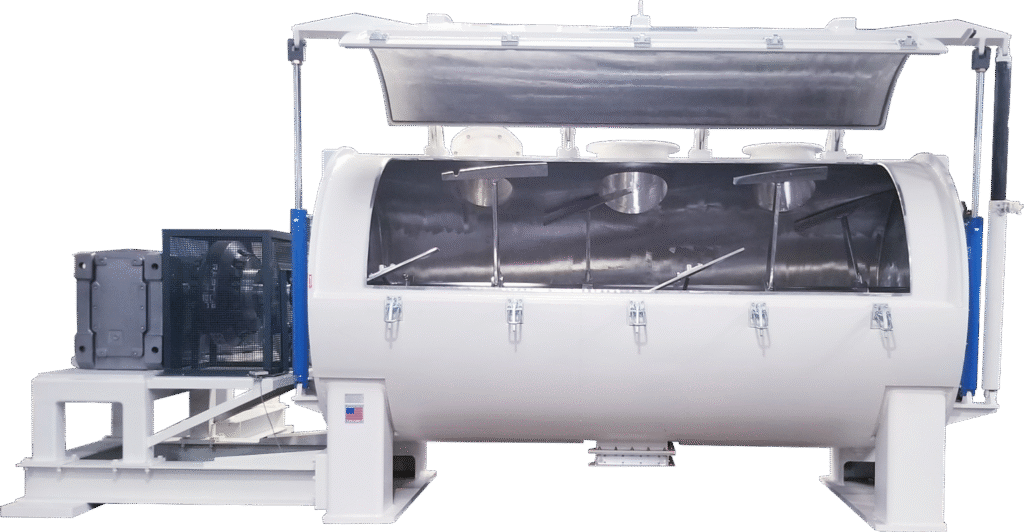
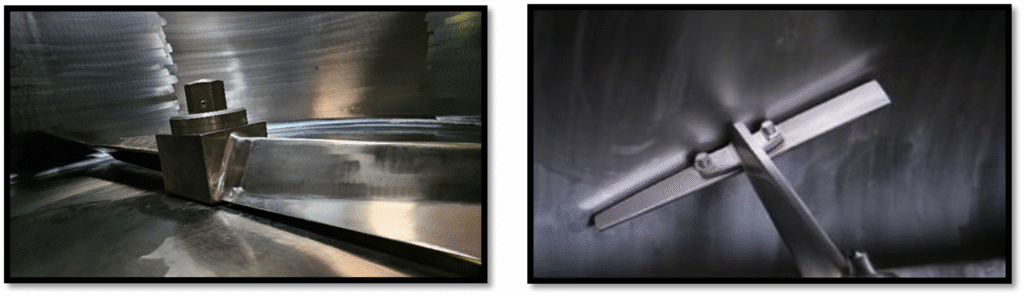
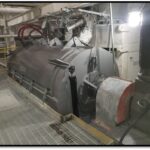
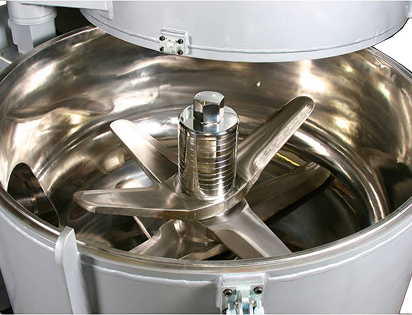
The horizontal process cooler is the more common configuration for high-volume PVC and powder processing operations. In a horizontal cooler, the mixing shaft runs horizontally through the centre of a cylindrical bowl. Dual-arm paddles are bolted to the shaft and span the full length of both arms, continuously throwing material against the inner wall for maximum surface contact with the cooled jacket. This paddle geometry is particularly effective for dense compounds and large batch sizes because it maintains consistent material circulation even as the batch volume decreases toward the end of the cooling cycle.
Reliance horizontal coolers are equipped with high-pressure jackets on both the cylinder and the lid, rated to 60 psi and designed to run at 40 psi, allowing greater water flow volume through the jacket, which directly shortens cooling cycle time.
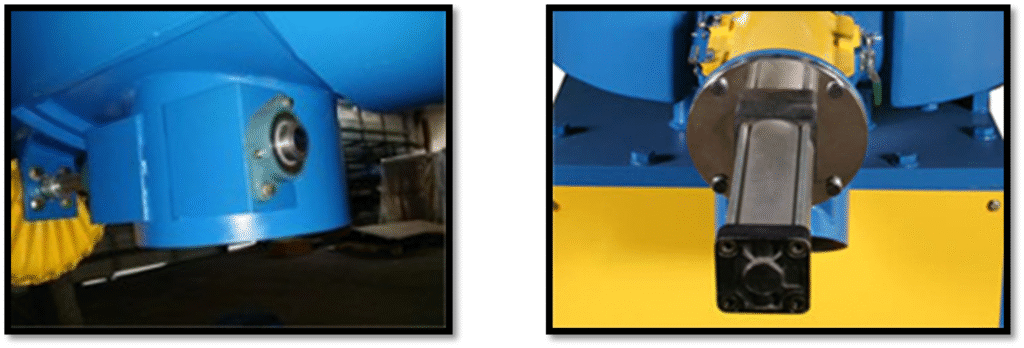
Discharge is via slide gate valves or flapper assemblies, both designed for fast, controlled release with minimal residue. Limit switches are installed to provide position feedback on the discharge plug, preventing operation until the plug is fully seated or fully open and ensuring safe, reliable batch release.
Cooling water inlet temperature and cycle time. The sub-6-minute cycle time reference is based on a 15°C cooling water inlet temperature. Plants running on ambient or tower water at 20°C to 25°C, particularly in warm climates or during summer months, will experience longer cycle times than the reference condition. If your facility’s cooling water supply runs warmer than 15°C, request adjusted cycle time calculations from Reliance based on your actual water supply temperature before finalising system sizing.
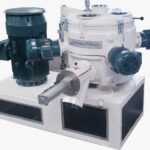
When to choose horizontal vs vertical? As a general rule, if floor space permits and batch sizes exceed 500L, horizontal coolers typically offer easier maintenance access and better performance at high throughput. If height constraints exist or batch sizes are smaller, vertical coolers deliver equivalent cooling performance in a more compact footprint. Vertical designs add cooling cones and humps to increase jacket surface area and partially compensate for the smaller footprint.
Cooling Mixer vs Air Cooling: Pros and Cons
Some lower-volume operations use forced air cooling or simply rely on residence time in a conveyor or bin to bring the compound temperature down before packaging. The table below compares the three approaches across the parameters that matter for production quality and throughput.
|
Parameter |
Jacketed Cooling Mixer |
Forced Air Cooling |
Ambient/Bin Cooling |
|
Cooling cycle time |
4–8 minutes |
20–45 minutes |
1–4 hours |
|
Temperature control |
Precise — target temp controlled |
Inconsistent — depends on the ambient |
Inconsistent — no control |
|
Batch-to-batch consistency |
High |
Moderate |
Low |
|
Agitation during cooling |
Yes — prevents caking, ensures even cooling |
Minimal |
None |
|
Risk of compound caking |
Minimal |
Moderate |
High |
|
Throughput impact |
None — matched to hot mixer cycle |
Significant bottleneck |
Severe bottleneck |
|
Capital cost |
Higher |
Lower |
Lowest |
|
Suitable for PVC dry blend |
Yes |
Marginal — only for low-output operations |
Not recommended |
|
Suitable for 24/7 production |
Yes |
No |
No |
For any operation running a high-intensity mixer in production volume, a jacketed cooling mixer is the only system that keeps the hot mixer from becoming a bottleneck and delivers the compound temperature consistency that downstream extrusion and moulding processes require.
Cooling Mixer Design: What Sets Reliance Apart
Jackets and Heat Transfer
The cooler jacket is the heart of cooling performance. Reliance designs its jackets with flow bars that create turbulent water flow, a mandatory feature for efficient heat exchange. Laminar flow through a plain jacket significantly reduces the heat transfer rate and extends the cycle time.
- Vertical coolers are fully jacketed around the cylinder, lid, and bowl bottom plate. Optional cooling cones expand jacket surface area for faster cooling on high-volume batches.
- Horizontal coolers carry high-pressure jackets on the cylinder and lid, engineered for maximum water flow and heat removal.
Thick-walled bowl construction provides heavy-duty durability and extended service life under the thermal cycling demands of continuous production.
Tools and Material Circulation
Reliance cooler tools are designed for continuous performance across every batch cycle. High-finished surfaces resist wear and extend tool life. Horizontal cooler dual-arm paddles are bolted to the shaft, spanning the full arm length to ensure material is continuously thrown against the inner wall for maximum jacket contact. Consistent circulation guarantees every batch cools evenly and reaches the target temperature without hot spots or caking.
Discharge System
Efficient discharge design is critical to maintaining throughput. Reliance coolers feature larger discharge openings that release material faster, shortening cycle times and improving batch handling.
- Horizontal coolers — equipped with slide gate valves or flapper assemblies for quick, controlled discharge
- Vertical coolers — supplied with pneumatic discharge plugs for efficient batch release
- Limit switches — installed to provide position feedback on discharge plugs in both horizontal and vertical coolers, ensuring smooth, reliable, and safe operation
Frequently Asked Questions: Cooling Mixers
Ready to Specify a Cooling Mixer System?
View Reliance Cooling Mixer Specifications or contact us to discuss your compound type, hot mixer output temperature, batch size, and required cycle time.
For operations running multiple powder coating formulations or frequent colour changes at lower volumes, see our container mixer guide as an alternative to high-intensity mixing for low-shear blending applications.