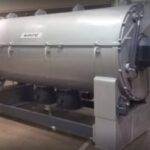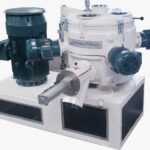
High-intensity mixers are the industrial standard for PVC compounding, rubber blending, pigment dispersion, and powder coating applications that demand fast, uniform, high-shear mixing. Reliance is among the most established high-intensity mixer manufacturers in North America, with over 40 years of engineering experience delivering consistent batch quality across some of the world’s most demanding production environments. Available in Standard, Direct Drive, and E-Series configurations, these systems are built to handle everything from routine pigment blending to high-volume, 24/7 compounding operations with reliable performance, minimal maintenance, and full customization options to match your exact production requirements.
Key Features of Reliance High Intensity Mixers
Reliance has engineered its high-intensity mixers to handle a variety of challenging applications. The following key features set these systems apart:
1. Versatile Models for Every Need
Three drive configurations are available: Standard, Direct Drive, and E-Series, each engineered to meet different production volumes, budget requirements, and operational demands.
- Standard models are ideal for general applications requiring consistent and reliable mixing
- Direct Drive models offer enhanced performance, ensuring smoother and more efficient operation
- E-Series models are cost-effective options without compromising high-intensity mixing capabilities
These options allow manufacturers to select the most suitable configuration according to their production volume, mixing intensity, and cost-efficiency requirements.
2. Precision Performance with Powerful Mixing Tools
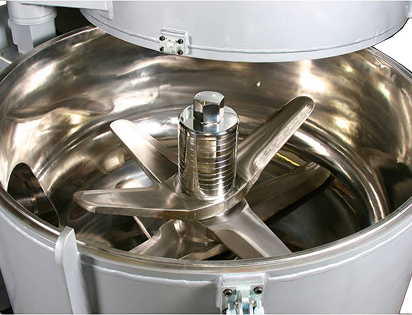
The mixing tools operate at high tip speeds and generate a deep vortex flow pattern in the bowl. This circulation is highly effective for material fluidization and thoroughly blending ingredients for uniform consistency. Tools are supplied with wear-resistant coatings, tungsten carbide, or ceramic hard-facing applied to the leading edges or the entirety of the tool body, depending on application requirements.
The tool’s geometry promotes self-cleaning action during operation, ensuring material does not accumulate on tool surfaces, reducing manual cleaning requirements between batches.
3. High-Efficiency Performance with Minimal Downtime
Reliance high-intensity mixers are engineered for energy-efficient operation, delivering high-shear mixing performance without excessive power draw. Maintenance access is designed into the machine (tool changes, lid removal, and discharge system), which can be completed quickly, minimising plant downtime and keeping production lines running across multi-shift operations.
4. Advanced Discharge and Lid Design
Discharge openings are sized to allow rapid and complete material transfer at the end of each batch cycle, reducing the time between batches and improving overall throughput. Larger openings reduce cycle times and increase throughput. Mixer lids are constructed from stainless steel with a leak-proof seal, preventing contamination during the mixing cycle.
High Intensity Mixer Technical Specifications
Specification | Standard Drive | Direct Drive | E-Series |
Bowl Size Range | 50L – 500L | 100L – 1,000L | 50L – 2,000L |
Tip Speed | 35 – 45 m/s | 40 – 50 m/s | 35 – 50 m/s |
Motor Power | 22 – 160 kW | 30 – 200 kW | 22 – 250 kW |
Drive Type | Belt/gearbox | Direct motor-to-shaft | Belt/gearbox |
Best For | General mixing, PVC dry blend, powder coating | High-shear rubber, pigment dispersion, masterbatch | High-volume, cost-efficient compounding |
Cooling Integration | Optional | Optional | Standard on larger models |
Control System | Manual or PLC | PLC-ready | PLC-ready |
Tool Coating | Tungsten carbide or ceramic hard-facing | Tungsten carbide or ceramic hard-facing | Tungsten carbide or ceramic hard-facing |
All models are available with custom bowl geometry, blade configurations, and discharge options. Contact Reliance to specify the configuration that fits your process.
Who Manufactures High-Intensity Mixers?
Not all high-intensity mixers are built the same, and choosing the right manufacturer is as important as choosing the right model. Here is what to evaluate before making a decision.
Certifications and compliance. A reliable manufacturer should, at a minimum, meet CE and UL safety standards. For North American buyers, it is important to confirm that electrical specifications align with local requirements. Standard facilities in the US and/or Canada typically run on 480V/60Hz, and any system supplied should be configured accordingly out of the box.
Customization range. Standard catalogue machines work well for general applications, but most industrial operations have at least one requirement that a fixed model cannot meet, such as a specific bowl volume, a non-standard blade profile, a unique discharge configuration, or an inert atmosphere design for reactive materials. A capable manufacturer will build based on your specifications rather than asking you to adapt your process to a fixed machine.
Service network and spare parts. Downtime on a mixer means downtime for your entire production line. Before purchasing, it is important to confirm that the manufacturer stocks spare parts domestically and can provide field service in your region. For operations in the United States and Canada, Reliance supplies equipment with local spare parts availability and technical support from its Missouri City, Texas, facility.
Lead time and delivery. Custom-built industrial mixers typically carry lead times of 12 to 20 weeks, depending on configuration. Confirm lead times in writing before ordering.
Track record. With over 40 years of manufacturing experience, Reliance has supplied mixing systems to PVC compounders, rotomolding operations, powder coating manufacturers, battery producers, and specialty chemical processors across North America and globally.
Industries That Use High-Intensity Mixers
These systems serve a broad range of industries wherever fast, uniform blending of powders, pigments, resins, or additives is required. Below are the primary sectors that rely on this technology.
- PVC Industry — The core equipment in PVC dry blend and compound production, used for mixing resin, stabilisers, plasticisers, and pigments into a uniform dry blend before extrusion or calendering.
- Rotational Molding Industry — Used to blend polyethylene powder with colorants and additives, achieving the particle size consistency and colour uniformity that rotomolded parts require.
- Anode & Cathode Industry — Battery Manufacturing — Used to blend electrode active materials, conductive additives, and binders for lithium-ion battery production, where dispersion uniformity directly affects cell performance.
- Powder Coating — Used to blend resin, hardener, pigment, and filler into a homogeneous powder before melt extrusion and chipping.
- Masterbatch, Pigments & Color Concentrates — Used to disperse pigments into carrier resins at high loading levels, achieving consistent colour strength across every batch.
- Rubber & Elastomers Industry — Used to distribute carbon black, accelerators, and process oils into the base polymer, improving dispersion uniformity and reducing mixing time for certain compound types.
- Pharmaceutical Industry — Dry Blending — Used for dry blending of active pharmaceutical ingredients with excipients where precise homogeneity is required.
- Metal, Ceramics & Glass Powder Processing — Used for metal powder, ceramic compound, and glass frit blending for advanced materials applications, including additive manufacturing, electronics, and specialty coatings.
Benefits of Reliance High Intensity Mixers
1. Consistency and Quality
Engineered to ensure consistent blending and dispersion, these systems guarantee that materials are thoroughly and evenly mixed every time, whether you are dispersing pigments for masterbatch production or compounding PVC dry blend.
2. Faster Production Cycles
Mixing cycles complete faster than conventional equipment, helping maximise plant productivity. Sub-6-minute cycle times are achievable for most standard PVC and powder coating applications under normal operating conditions.
3. Durability and Longevity
Heavy-duty materials coupled with precision engineering allow these systems to endure the rigours of continuous production. With proper maintenance, service life extends for many years, minimising downtime and keeping production lines running.
Applications
Common applications across industries include:
- Pigment dispersion for plastics — ensures uniform colour distribution in plastic compounding
- Additive blending — mixing various additives into resins or compounds for a homogeneous product
- Chemical compounding — precise blending of chemical powders, additives, and carrier materials into uniform compounds
- Powder coating — quick and efficient blending, ensuring uniform colour and texture
- PVC compounding — for PVC applications, the high-intensity mixer is paired with a cooling mixer to rapidly stabilise compound temperature before discharge
Control Systems for Optimized Mixing
One of the standout features of these mixing systems is their control system capability. PLC-based control automates essential steps such as mixing time, speed, and temperature, with recipe management ensuring each batch follows the same parameters regardless of which operator is running the line. The control systems also allow for easy integration with the weighing and conveying setups of the plant, and with real-time monitoring and data insights, operators can track production performance and make adjustments that optimize consistency across long production runs. This eliminates the batch-to-batch variation that manual parameter setting introduces in multi-shift operations and provides full batch data logging for traceability.
Frequently Asked Questions: High Intensity Mixers
Ready to Specify Your High Intensity Mixer?
View specifications or contact us to discuss your bowl size, drive configuration, material type, and production volume requirements.