Reliance Mixers is based in Missouri City, Texas, and has supplied high-intensity mixers to manufacturers across the United States and Canada since 1982. If you are evaluating high-intensity mixer manufacturers in North America, this guide covers what distinguishes a reliable manufacturer from a catalogue supplier, what specifications matter for North American production environments, and what questions to ask before committing to a purchase.
Request a quote with a confirmed delivery timeline — Reliance ships to the US and Canada.
What Makes a High-Intensity Mixer Manufacturer Reliable?
Buying a high-intensity mixer is a capital equipment decision with a 15-to-25-year operational life. The manufacturer you choose determines not just the quality of the machine at delivery, but whether you can get spare parts in year 10, whether a field technician can reach your facility when something fails, and whether the machine was built to your actual process requirements or adapted from a generic catalogue specification.
The following criteria separate manufacturers who are reliable long-term partners from suppliers who simply fulfil an order.
Build quality and materials. The mixer bowl, tools, lid, discharge assembly, and bearing housing must all be fabricated from the correct grade of stainless steel for the application. For PVC, rubber, and chemically aggressive compounds, 316 stainless steel or 304 stainless steel with appropriate surface treatments is the minimum. A manufacturer who offers only one bowl material option regardless of application is working from a product catalogue, not an engineering specification.
Certifications and compliance. For North American buyers, the machine must comply with local electrical and safety standards. Confirm CE marking for general machinery safety compliance and UL listing or equivalent for electrical components. OSHA compliance for guarding and interlock systems is a non-negotiable requirement for any mixer operating in a US or Canadian facility. For Canadian installations, confirm CSA certification alongside UL listing; both are required for equipment installed in Canadian production plants. A manufacturer unfamiliar with North American compliance requirements will create problems at installation and inspection.
Customization capability. Most production environments have at least one requirement that a standard catalogue machine cannot meet: a specific bowl volume, a non-standard discharge configuration, a blade profile for an unusual compound, or an inert atmosphere design for reactive materials. A manufacturer with genuine engineering capability builds to your specification. A catalogue supplier will tell you to adapt your process to fit their standard model.
After-sales service and spare parts. Ask directly: where are spare parts stocked? What is the typical lead time for wear parts, tools, gaskets, and bearing housings? Is field service available in the US and Canada, and what is the typical response time? A manufacturer based overseas with no North American service presence leaves you managing repairs through international shipping and time zone gaps.
Delivery lead time. Standard configurations from a manufacturer with North American operations typically ship in 12 to 16 weeks. Fully custom designs run 16 to 24 weeks. Any manufacturer quoting shorter lead times for complex custom configurations should provide written confirmation of the delivery date at the time of order.
Track record. Ask for references from North American customers in your industry. A manufacturer who has supplied PVC compounders, powder coating operations, or rotomolding facilities in the US or Canada has demonstrated the ability to meet North American operating conditions, electrical standards, and service requirements.
Manufacturer Evaluation Checklist
Use this checklist when requesting quotations from high-intensity mixer manufacturers.
|
Criteria |
What to Ask |
Why It Matters |
|
Electrical specification |
Is the machine configured for 480V/60Hz as standard for the US/Canada? |
Wrong voltage specification requires costly field modification or transformer installation |
|
Safety compliance |
Does the machine carry CE marking and comply with OSHA guarding requirements? |
Required for facility insurance, regulatory inspection, and safe operation |
|
Canadian compliance |
Does the machine carry CSA certification for Canadian facility installation? |
Required for Canadian regulatory inspection alongside UL listing |
|
Bowl material |
What grade of stainless steel is used for the bowl and tools? Is hard-facing or wear coating available? |
Determines chemical compatibility and service life for your specific compound |
|
Customization |
Can bowl volume, blade profile, discharge configuration, and control system be specified to our requirements? |
Ensures the machine fits your process rather than forcing your process to fit a standard machine |
|
Spare parts |
Are wear parts stocked in North America? What is the lead time for tools, gaskets, and bearing components? |
Determines downtime exposure when maintenance is required |
|
Field service |
Is installation and commissioning support available in the US and Canada? |
Required for initial setup and for urgent troubleshooting during production |
|
References |
Can you provide references from North American customers in our industry? |
Validates operating experience in comparable production environments |
|
Delivery |
What is the confirmed lead time for our configuration, in writing? |
Establishes a realistic production planning timeline |
|
Warranty |
What is the warranty period, and what does it cover? |
Clarifies cost exposure during the early operational period |
High Intensity Mixer Specifications: North American Standard Designs
North American production facilities have specific electrical and safety requirements that affect how a high-intensity mixer must be specified. The following parameters are the baseline for any mixer being installed in a US or Canadian facility.
Electrical standard. North American facilities operate on 480V/60Hz three-phase power as the standard industrial supply voltage. Mixers supplied from European or Asian manufacturers are typically configured for 400V/50Hz and require either a step-up transformer or full electrical reconfiguration before installation. Reliance, as a US-based manufacturer, supplies all standard production mixers configured for 480V/60Hz as the default specification.
Motor sizing. North American motor standards follow NEMA frame sizing conventions. Motors must be NEMA-rated or equivalent for correct coupling to the drive train. Confirm that the manufacturer uses NEMA-standard motors or can supply motors that are directly interchangeable with NEMA frames to simplify future replacement.
Safety guarding and interlocks. OSHA 1910.212 requires machine guarding on all moving parts. The mixer lid must be interlocked with the drive system so the motor cannot run with the lid open, and all rotating components must be guarded to prevent contact during operation. Confirm that the machine ships with guarding installed and that interlock systems are tested before delivery.
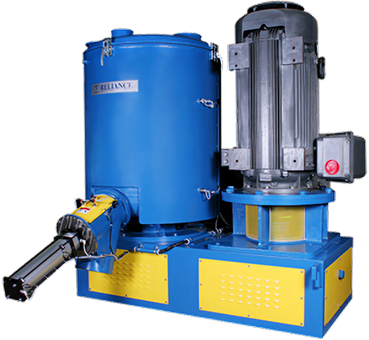
Bowl capacities for North American production. Standard production volumes in North American PVC, powder coating, and rotomolding operations typically call for bowl sizes in the 200L to 1,000L range for mid-size plants, with 500L to 2,000L for high-volume continuous operations. Reliance supplies bowls from 50L through 2,000L, with the full range available in US/Canada-compliant configurations.
Control systems. PLC-based control systems for North American installations should be configured with Allen-Bradley, Siemens, or equivalent US-market PLC hardware for which local engineering support is readily available. Proprietary control systems from overseas manufacturers can create long-term support problems when software updates or replacement components are required.
High Intensity Mixer Lid, Discharge, and Tools: Why Component Design Determines Performance
The lid, discharge, and tools are the three components that most directly determine batch quality and operational reliability.
Lid. The mixer lid maintains a sealed, controlled environment during high-speed mixing. Leak-proof sealing prevents material loss and contamination. Stainless steel construction resists wear, corrosion, and thermal stress. Smooth internal surfaces minimize material buildup between batches. For North American facilities running frequent batch changes, Clam-Shell, Swivel, or Pivot/Tilt lid designs are available to match different loading configurations.
Discharge. The discharge system determines how quickly and completely the bowl empties between batches. Large-diameter discharge openings — Reliance supplies up to 12-inch openings, reducing cycle time and residue. Pneumatic discharge assemblies with contoured plugs ensure complete emptying with minimal manual intervention. For color-sensitive applications, mirror-polished discharge surfaces minimise pigment retention between batches.
Tools. Mixing tools create the deep vortex flow pattern that achieves uniform blending. Wear-resistant coatings on the tool leading edges, tungsten or ceramic hard-facing, are standard on Reliance tools to extend service life in abrasive applications. Self-cleaning profiles minimise material buildup on the tool surface between cycles. Tool configuration is matched to the application of different blade geometries for PVC dry blend, masterbatch, rotomolding powder, and rubber compounding.
Why North American Manufacturers Choose Reliance
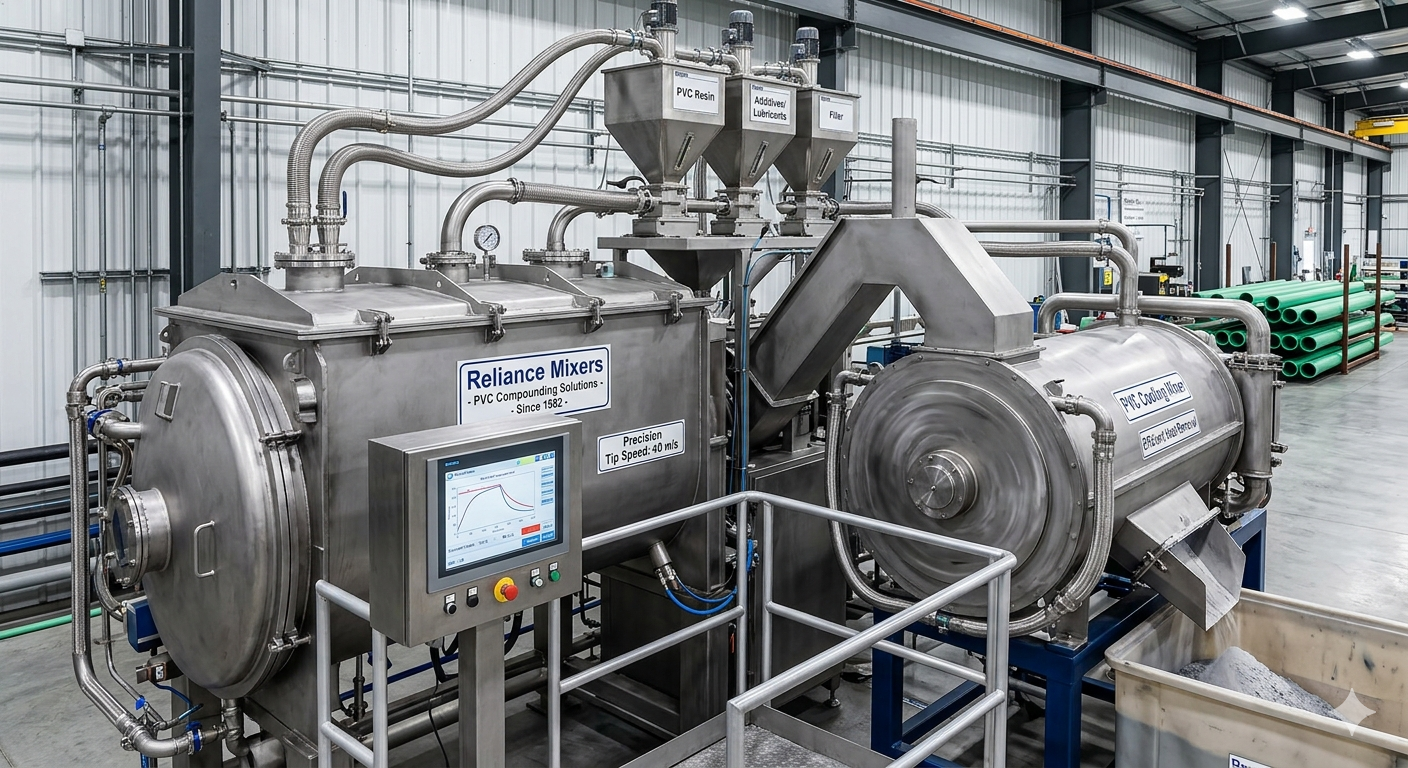
Reliance Mixers, headquartered in Missouri City, Texas, has supplied high-intensity mixing systems to manufacturers across North America since 1982. The combination of US-based manufacturing, North American electrical and safety compliance as standard, domestic spare parts availability, and direct field service coverage across the US and Canada makes Reliance the practical choice for North American buyers who need a reliable long-term equipment partner rather than an overseas import.
View high intensity mixer specifications or get a North America quote with a confirmed delivery timeline.