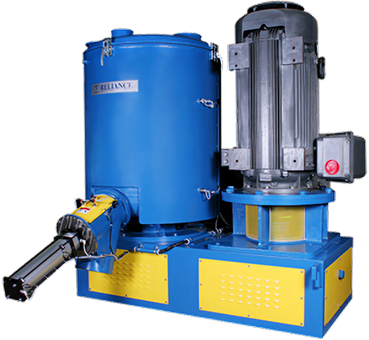
High-intensity plastic mixers are specialized batch mixing machines designed to achieve uniform dispersion of pigments, fillers, and additives in plastic formulations. Featuring precision-engineered lids, bowls, discharge systems, and mixing tools, these machines enable North American manufacturers to reduce batch cycle times, minimize waste, and maintain consistent product quality across large production volumes.
Reliance Mixers has been manufacturing high-intensity mixers since 1982 and is widely used by plastic, chemical, and battery manufacturers in North and South America.
What Is a High-Intensity Plastic Mixer?
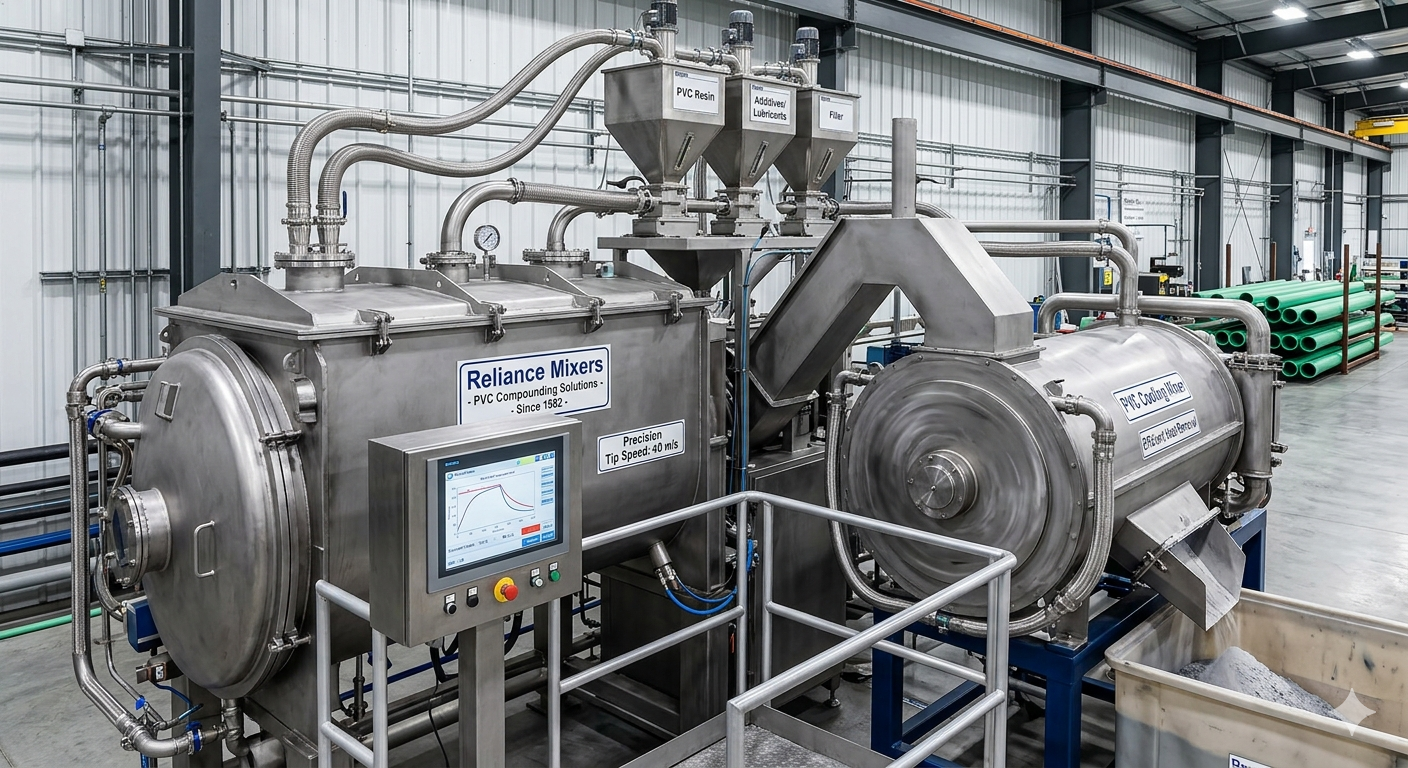
A high-intensity plastic mixer is a machine used for batch mixing plastic materials. It has fast-spinning blades inside a stainless steel bowl. These blades spin at very high speeds, over 25 meters per second, and may reach 40 m/s with PVC material. Due to the high speed of these blades, a vortex, or swirling motion, is created inside the bowl.
The high speed of the blades creates strong mixing forces and friction, which helps in:
- Even distribution of pigments, fillers, and additives.
- Mixing of material quickly and efficiently.
Common uses of high-intensity plastic mixers
A high-intensity plastic mixer is used for various mixing applications in the plastic industry.
- Blending PVC resin with additives such as stabilizers, lubricants, fillers, and pigments.
- Dispersing pigments and preparing a masterbatch.
- Blending plastic additives.
- Powder coating pre-mixing and preparing a color concentrate.
The performance of high-intensity plastic mixers depends significantly on the design and material of high-intensity mixer tools, including blade geometry, tool height, and rotational speed, all of which are configured by Reliance to suit specific material and batch requirements.
With the development of modern mixers, including those from Reliance Mixers, the need to balance speed, blade, and bowl configurations in high-intensity plastic mixers has been met.
The Role of High-Intensity Mixer Lid for North American Manufacturers
The high-intensity mixer lid directly influences sealing integrity, operator safety, cleaning efficiency, and batch accessibility, each factor affecting overall production throughput.
Reliance high-intensity mixer lids are leak-proof. To ensure a tight fit between the mixers and bowls for rapid mixing without leakage, these mixers feature flanges and domes. The lids’ design and execution will significantly minimize waste while keeping your workspace neat.
Stainless steel is used for most Reliance mixers’ lids, providing the durability and cleaning ease that high-volume production environments demand. Because they are resistant to heat, abrasion, and chemical corrosion, the lids facilitate mixing various products.
Each factory’s space, equipment, and maintenance will vary depending on its specific requirements. Designed and manufactured to meet North American operational standards, Reliance’s mixer lids are available in clamshell, swivel, and tilting configurations to suit varying factory layouts and production requirements.
High-Efficiency Discharge Systems for Faster Throughput
The high-intensity mixer discharge system can either be too slow to produce quickly or too fast to maintain good quality production rates.
- Larger Discharge Openings
Reliance mixers are engineered with oversized discharge openings to allow rapid material transfer at the end of each batch cycle. The faster the material clears the mixer, the sooner the next batch can begin, directly reducing total cycle time.
- Better Plant Productivity
Reliance mixers are engineered with discharge openings ranging from 2 to 12 inches, designed to minimize material retention between batches and reduce colour changeover time, directly improving throughput in high-volume PVC compounding and masterbatch production.
High Intensity Mixer Bowl Systems for Plastic Applications
The high-intensity mixer bowl governs temperature control, cleaning ease, mixing force, and overall blend quality, making bowl design critical to consistent production outcomes.
- Stainless Steel Bowl
Reliance mixer bowls are precision-engineered in stainless steel to enhance cleaning efficiency and withstand the thermal and chemical demands of PVC compounding, colour masterbatch production, and powder coating applications.
- Wear-Resistant Coating
Bowl interiors are available with a wear-resistant coating, extending service life when processing abrasive materials such as mineral-based compounds and powder coatings.
Case Study: Modernizing a North American Plastic Compounder’s High-Intensity Mixing System
High-intensity mixers are utilized in several industries in North America that require materials to be mixed at high speeds, evenly, and under controlled conditions. They require specialized mixers with a secure closure system, an advanced mixing bowl, a high-intensity lid, and a proper discharge system.
A North American plastic compounder was operating outdated high-intensity mixers from an international manufacturer, resulting in long batch cycle times, slow discharge rates, and excessive downtime due to wear on mixing bowls and tools.
Through a partnership with Reliance, the compounder’s high-intensity mixers were rebuilt and modernized, larger discharge openings were added, wear-coated mixing bowls were furnished, and high-intensity mixer lids specifically designed for the PVC and filler combination were installed.
As a result of the high-intensity mixer discharge and bowl, the plant achieved measurable reductions in batch cycle time and material retention between colour changes, improving overall throughput and reducing waste associated with colour changeovers.
Why North American Manufacturers Choose Reliance High-Intensity Mixers
Reliance Mixers has been manufacturing industrial mixing equipment in Missouri City, Texas, since 1982. Their mixers are used in industries that produce plastics, chemicals, batteries, food products, medicine, and rubber.
Reliance mixers are built with precise machine components and hard-wearing tool and bowl materials. Unlike standard mixer suppliers, Reliance engineers each system to the specific material and production requirements of the customer, whether that involves PVC compounding, masterbatch production, powder coating, or chemical processing.
For North American manufacturers seeking reliable, high-performance mixing equipment, Reliance Mixers offers a proven solution built on four decades of industry experience.
Conclusion
High-intensity plastic mixers perform at their best when every system component, such as the lid, bowl, discharge mechanism, and mixing tools, is engineered to work together under demanding production conditions.
Reliance Mixers addresses each of these requirements with purpose-built designs developed specifically for North American plastic manufacturers. Leak-proof lid systems in clamshell, swivel, and tilting configurations ensure sealed, safe operation. Stainless steel and wear-resistant bowl systems maintain temperature control and withstand abrasive materials across long production runs. Large-opening discharge systems reduce batch changeover time and material waste. And precision-engineered mixing tools deliver the high shear forces needed for uniform dispersion of pigments, fillers, and additives in PVC compounds, masterbatch formulations, and powder coatings.
For manufacturers looking to reduce cycle times, improve consistency, and modernize aging mixing equipment, Reliance Mixers provides the components, expertise, and North American manufacturing support to make that transition effective.
Contact Reliance Mixers to discuss your mixing requirements or request a quote.