
Since 1982, Reliability in
Every Batch
PVC Mixers
Reliance Mixers builds PVC mixers and complete PVC mixing systems for facilities that compound dry blends, masterbatch, and specialty PVC formulations. Every system is engineered around the thermal profile of the PVC compounding cycle, matched heating mixers and cooling mixers that operate in overlapping cycles to produce consistent compound output without bottlenecks.
Optimizing Your PVC Mixers Through Advanced Mixing Technology
PVC Mixers from Reliance are built for facilities that compound dry blends, masterbatch, and specialty PVC formulations. Every system is engineered around the thermal profile of the PVC compounding cycle and the production requirements of the specific application. Equipment is built and supported from the company’s Missouri City, Texas, facility.
Key Highlights:
- Matched heating and cooling mixer systems that operate in overlapping cycles
- Sub-6-minute cooling batches with jacketed vessel design
- Tip speeds up to 40 m/s for complete pigment and additive dispersion
- PLC controls with recipe management and batch logging
- Domestic manufacturing and parts inventory from Texas
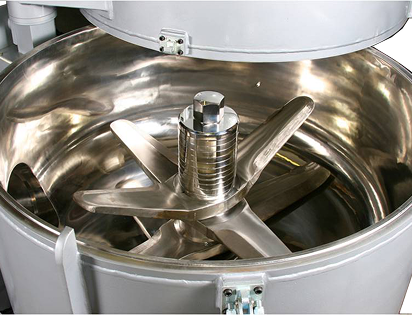
Industrial PVC Mixing Systems for Efficient Material Processing
PVC compounding requires precise control over heat, shear, and timing. The resin must reach a specific temperature window to accept additives and pigments, but excessive heat degrades the material. Poor dispersion creates color streaks, weak mechanical properties, and downstream processing defects that cannot be corrected after the mixing stage.
Industrial PVC mixing systems from Reliance address these requirements through:
- Controlled tip speed that generates sufficient shear for pigment breakdown without overheating
- Temperature monitoring that tracks batch thermal profile in real time
- Automated discharge timing that transfers the hot compound to the cooling immediately upon reaching the setpoint
- PLC controls that log every batch for quality tracking and process verification
- Matched heating and cooling capacities that prevent bottlenecks at either stage
The result is consistent dry blend quality that feeds reliably into extrusion, injection molding, or calendering operations. Facilities avoid the blocked silos, inconsistent feeding, and surface defects that poor mixing creates.
Types of PVC Mixers We Offer
Reliance manufactures three core mixer types for PVC processing, each engineered for a specific stage of the compounding cycle.
PVC High Speed Mixer
PVC high-speed mixers perform the heating and intensive mixing stage of PVC compounding. The mixing tool operates at tip speeds up to 40 meters per second, generating the shear required to:
- Break down pigment agglomerates into a uniform particle distribution
- Distribute calcium carbonate fillers, stabilizers, and lubricants throughout the resin matrix
- Soften the PVC particle surface through controlled frictional heat, enabling additive penetration
The mixing cycle completes in 4 to 7 minutes, depending on formulation complexity and batch size. Temperature, time, and motor amperage signals control the cycle endpoint, ensuring repeatable batch performance. Vortex flow design eliminates dead zones, while deflectors redirect material back through the high-shear zone until dispersion is complete.
Reliance configures batch sizes from lab-scale units to production systems handling several hundred liters per cycle.
PVC Cooling Mixers
PVC cooling mixers receive hot compound directly from the high-speed mixer at temperatures up to 120°C (245°F). At this temperature, the dry blend is thermally active and prone to agglomeration if allowed to cool in static conditions. The cooling mixer must reduce the temperature below 45°C rapidly and uniformly before discharge to storage or extrusion feed.
Reliance PVC cooling mixers achieve this through:
- Jacketed vessel design with full coverage on the cylinder
- 3- and lid
- Internal flow bars that create turbulent water circulation for maximum heat transfer
- Paddle arms (horizontal design) or bottom-riding tools (vertical design) that continuously move material against the cooled vessel wall
- Sub-6-minute cooling cycles validated in production environments
The company offers both horizontal and vertical configurations. Horizontal units use paddle arms covering the full vessel length, with optional jacketed end plates for additional cooling surface. Vertical units provide cooling on the cylinder and bottom plate, with optional cooling cones to increase surface area on larger capacities. Both designs include large discharge openings for fast material removal and limit switches that provide PLC-ready feedback on valve position.
Wall thickness runs up to twice that of comparable European equipment, extending service life under continuous thermal cycling.
PVC Vertical Mixer Machine
Vertical mixer configurations suit facilities where floor space is limited or where gravity discharge into downstream equipment is advantageous. The vertical cooling mixer design places the drive above the vessel, with tools along the bottom bowl to move material continuously against the surfaces.
Key characteristics include:
- Compact footprint relative to batch capacity
- Bottom discharge through a pneumatically operated plug for controlled emptying
- Jacket coverage on the cylinder and the bottom plate is standard
- Optional cooling cones and humps to increase the effective cooling surface on larger units
- Mirror-finish or coated tool options for abrasive formulations
Vertical and horizontal cooling mixers both achieve the sub-6-minute cooling standard. The selection between them depends on plant layout, available headroom, material characteristics, and integration with existing material-handling systems.
Key Features of Our PVC Mixer Machines
- High-efficiency motors sized for actual process loads
- Variable frequency drives that adjust mixing intensity through each cycle phase
- Temperature monitoring with automated alerts for thermal excursions
- Reinforced steel frames with up to 2x standard wall thickness on cooling vessels
- Accessible arms, paddles, and lid openings for maintenance
- PLC-based recipe management and batch logging
- Automated discharge systems that reduce changeover time
- Stainless steel construction with optional mirror-polished surfaces
Applications in the PVC Industry
- Pipe and profile manufacturing: rigid PVC compounds for pressure pipe, drainage, and window profiles
- Cable and wire compounds: flexible PVC with plasticizer systems for insulation and jacketing
- Film and sheet production: calendering compounds requiring a consistent thermal history
- Injection molding: dry blends for fittings, connectors, and housings
- High-filler formulations: calcium carbonate-loaded compounds for cost reduction
- Masterbatch and color concentrate: concentrated pigment dispersions for let-down
- Specialty compounds: heat-stabilized, UV-stabilized, and impact-modified formulations
Benefits of Using Reliance PVC Mixers
Productivity improvement. Matched heating and cooling mixer capacities with overlapping cycle timing produce near-continuous compound output. When sized at 2 to 4 times heating mixer capacity, the cooling stage does not bottleneck throughput.
Energy efficiency. Controlled shear and optimized motor sizing match power input to actual material requirements.
Reduced downtime. Domestic parts inventory from the Texas facility eliminates overseas lead times. Engineers who designed the system provide direct technical support.
Precise mixing. Tip speed, blade geometry, and cycle control parameters are configured for the specific formulation.
Long machine lifespan. Heavy-wall construction, wear-resistant tool coatings, and rebuild capability extend operational life.
Technical Specification
Specification | Detail |
Mixer Types: | High-intensity heating mixer, horizontal cooling mixer, vertical cooling mixer |
Heating Mixer Tip Speed: | Upto 40m/s |
Heating Cycle Time: | 4-7 minutes |
Cooling Cycle Time: | Sub-6 minutes |
Cooling Mixer Designs: | Horizontal and vertical |
Jacket Coverage: | Full cylinder + lid; optional end plates (horizontal), cooling cones (vertical) |
Wall Thickness: | Up to 2× European competitor standard |
Discharge: | Slide gate or flapper (horizontal); pneumatic plug (vertical) |
Control Systems: | PLC with recipe management, batch logging, temperature/amperage monitoring |
Construction: | Stainless steel with optional mirror finish |
Tool Options: | Standard, hard-surfaced, or coated for abrasive materials |
Batch Sizes: | Lab-scale to production capacity |
Manufacturing Location: | Missouri City, Texas |
Why Choose Reliance Mixers?
Application-specific engineering. Every PVC mixer is configured around the formulation, batch size, and production targets. A pipe compounder running high-filler rigid PVC receives different blade geometry, cooling capacity, and control parameters than a cable manufacturer processing plasticized flexible compounds.
Domestic manufacturing and support. Equipment is built in Texas. Replacement parts ship from domestic inventory. Technical questions route to engineers who can reference the actual design drawings.
Rebuild and upgrade capability. Reliance rebuilds and enhances mixers originally manufactured by Henschel, Prodex, Plasmec, and Littleford. Rebuilds often improve cycle times and extend operational life.
Quality verification before shipment. Mechanical operation, seal integrity, drive performance, and control function are tested under simulated production conditions before the unit leaves the facility.
Regulatory-ready documentation. PLC controls generate batch records suitable for quality management systems.
Get to Know Our PVC Mixers Better
At Reliance Mixers, we go above and beyond simply providing the finest mixing equipment in the industry. Leave us a message, and we’ll get back to you shortly!
Frequently Asked Questions
What are PVC mixers used for?
PVC mixers compound dry blends of PVC resin with additives, pigments, fillers, and stabilizers. The mixing process distributes these components uniformly and prepares the material for downstream extrusion, molding, or calendering. Without proper mixing, PVC products develop color variation, weak mechanical properties, and surface defects.
What is the difference between PVC high-speed mixers and PVC cooling mixers?
PVC high-speed mixers perform the heating and intensive dispersion stage. They operate at high tip speed to generate shear and controlled frictional heat. PVC cooling mixers receive the hot compound and reduce its temperature rapidly through jacketed vessels with turbulent water flow. The two units work as a matched system.
Which industries use PVC mixing systems?
PVC mixing systems serve pipe and profile manufacturing, wire and cable insulation, film and sheet production, injection molding, and specialty compounding for construction, automotive, and consumer products.
Can PVC mixer machines be customized?
Yes. Reliance configures tip speeds, blade geometry, cooling capacity, vessel design, batch size, and control parameters for the specific formulation and production requirements.
Why choose Reliance Mixers for PVC mixing solutions?
Reliance has manufactured mixing equipment in Texas since 1982. The company provides application-specific engineering, domestic parts and support, rebuild capability, and factory performance verification before shipment.