In plastic manufacturing, inconsistent mixing creates defects, waste, and production delays. When raw materials blend unevenly, the final product suffers, resulting in rejected batches and lost revenue. Advanced plastic compounding solutions improve product quality by ensuring uniform dispersion of additives, stabilizers, and pigments. This blog explains how precise mixing technology delivers consistent results for PVC processors.
What Is Plastic Compounding?
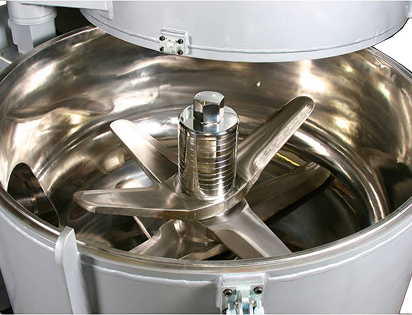
Plastic compounding blends base resins like PVC with additives including stabilizers, color pigments, and fillers. The goal is to create homogeneous dry mixtures for downstream molding and extrusion. Without proper mixing, products show uneven color dispersion and reduced mechanical properties.
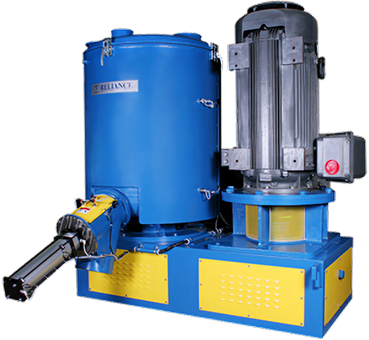
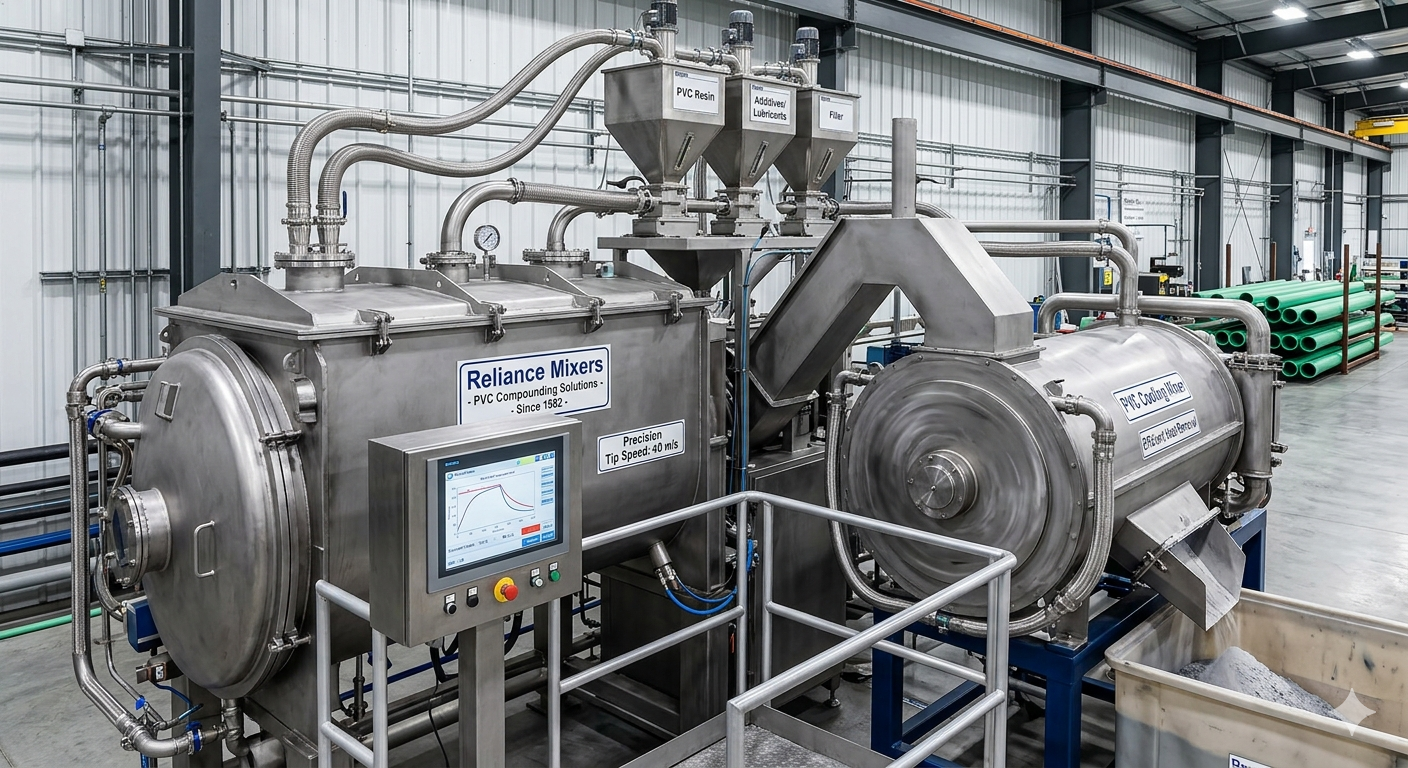
A plastic compounding mixer solution ensures that additives distribute uniformly throughout the PVC matrix. Reliance Mixers‘ high-intensity heating and cooling systems provide the controlled shear and temperature management required for consistent results.
Key Challenges in Traditional Compounding
Some challenges that manufacturers face with traditional compounding include:
- Inconsistent mixing creates dead zones, leading to poor additive dispersion
- Batch-to-batch variation forces constant adjustments and causes defects
- Color matching issues arise from pigment clumps and shade variations
How Advanced Mixers Solve These Issues
Modern plastic compounding solutions improve product quality through integrated heating and cooling mixer combinations. These systems deliver:
- High-intensity mixing with tip speeds up to 40 m/s for optimal shear and dispersion
- Uniform material distribution throughout the mixing vessel
- Temperature-staged addition protocol: initial resin heating, followed by stabilizers, processing aids, plasticizers, lubricants, and fillers at optimal temperatures
- Enhanced cooling design with full jacket coverage of the lid and cylindrical body, validated through CFD analysis
- Fast and efficient discharge from both mixer and cooler, with cooling cycles finishing before discharge temperature requirements
- Up to twice the steel thickness of inside cylinders compared to European competitors
This process increases production rates with reduced waste.
Real-World Applications in PVC Industries
PVC Pipe Extrusion
Proper mixing of raw materials supports consistent extrusion and prevents dimensional instability. It improves pipe quality, making wall thickness more even and consistent so pipes can handle pressure reliably.
PVC Profiles (Windows and Doors)
Even filler distribution during mixing makes window profiles stronger. Proper compounding helps reduce warping and dimensional changes during manufacturing and daily use.
Why Choose Reliance Mixers
If inconsistent mixing affects your product quality, the solution lies in upgrading your mixing process. Reliance Mixers designs plastic compounding mixer solutions specifically for PVC demands, delivering consistent results and improved production efficiency.
Our engineering team understands the critical relationship between mixing parameters and final product properties, helping you achieve optimal results while maximizing throughput with specialized High Intensity Mixer and Cooling-Mixer systems.
Case Study: A PVC pipe manufacturer using the Reliance FM-500 with precision temperature control achieved:
- Batch-to-batch variation reduced from 8% to 2%
- Cycle time decreased by 4 minutes
- Annual throughput increased by 15%
Operating from our Texas facility, we provide replacement parts from US inventory, direct access to application engineers, on-site commissioning and training, and rapid technical support response.
Ready to elevate your mixing process? Contact our experts to discuss how our plastic compounding solutions improve product quality in the PVC industry.