Selecting the right industrial mixer isn’t just a purchasing decision; it’s a production strategy. At Reliance Mixers, we’ve seen how the wrong mixing equipment can create bottlenecks, waste material, and compromise batch quality. We’ve also seen how the right paddle mixer transforms dry blending from a variable process into a controlled, repeatable operation.
Since 1982, we’ve engineered paddle mixer solutions in Missouri City, Texas, that handle everything from fragile food powders to dense chemical granules. This guide shares what we’ve learned about matching paddle mixer design to material behavior, and why domestic manufacturing matters when you need support without delays.
What Is a Paddle Mixer and When Do You Need One?
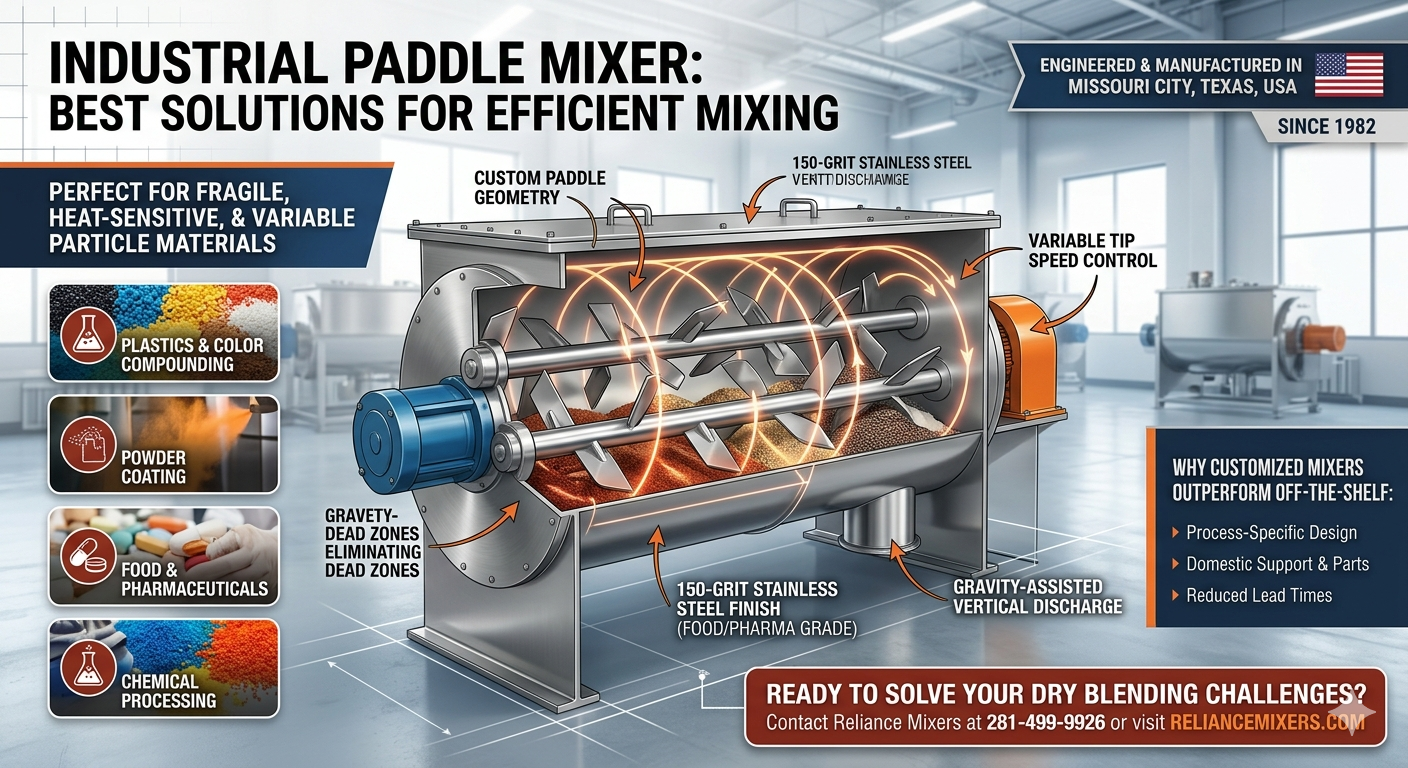
An industrial paddle mixer uses rotating paddles to blend materials through a gentle tumbling action. Unlike high-shear mixers that apply intense energy, paddle mixers lift, fold, and cascade materials in a controlled figure-eight pattern that preserves particle integrity.
The mixing action works through dual shafts with pitched paddles that move material from the bowl bottom up the center, then back down the sides. This creates three-dimensional circulation that eliminates dead zones without the aggressive shear that damages fragile ingredients.
You need a paddle mixer when your materials are:
- Fragile or friable: Food ingredients, pharmaceutical powders, or specialty chemicals that degrade under high shear
- Heat-sensitive: Formulations where friction-generated heat causes degradation or premature reaction
- Variable in particle size: Mixtures with different densities that require gentle folding to achieve uniformity
Horizontal paddle mixers position the shaft parallel to the floor, creating circular flow ideal for continuous operation. Vertical designs orient the shaft upward, handling moderately cohesive materials with gravity-assisted discharge.
Why Customized Industrial Mixers Outperform Off-the-Shelf Equipment
Every material behaves differently under shear, temperature, and mixing time. PVC compounds, color concentrates, food blends, and chemical formulations each require specific intensities and control parameters. Generic mixers force manufacturers to adjust their processes around equipment limitations. Custom industrial mixers reverse that relationship.
At Reliance, we engineer paddle mixers around your specific requirements:
- Tip speed matched to material sensitivity: Fragile formulations receive slower, gentler blending. Robust materials handle higher speeds for faster cycle times without degradation.
- Paddle geometry configured for your blend: Flat paddles create minimal shear for delicate ingredients. Angled or curved paddles increase intensity for cohesive materials requiring more energy.
- Surface finish for your industry standard: Stainless steel 304 or 316L with 150-grit polish for food and pharmaceutical applications where contamination control is critical. Standard steel or specialty alloys for chemical processing.
- Discharge designed for your downstream process: Horizontal discharge integrates with conveyors and pneumatic systems. Vertical discharge uses gravity for simple, complete evacuation that speeds changeovers.
Our in-house manufacturing in Missouri City means custom configurations ship without overseas lead times. We source components domestically, maintaining inventory for fast replacement and minimal downtime. When you call 281-499-9926, you reach our engineers directly and not a service center halfway around the world.
How Paddle Mixers Deliver Better Dry Blending Results
We’ve seen paddle mixers solve specific production challenges across industries:
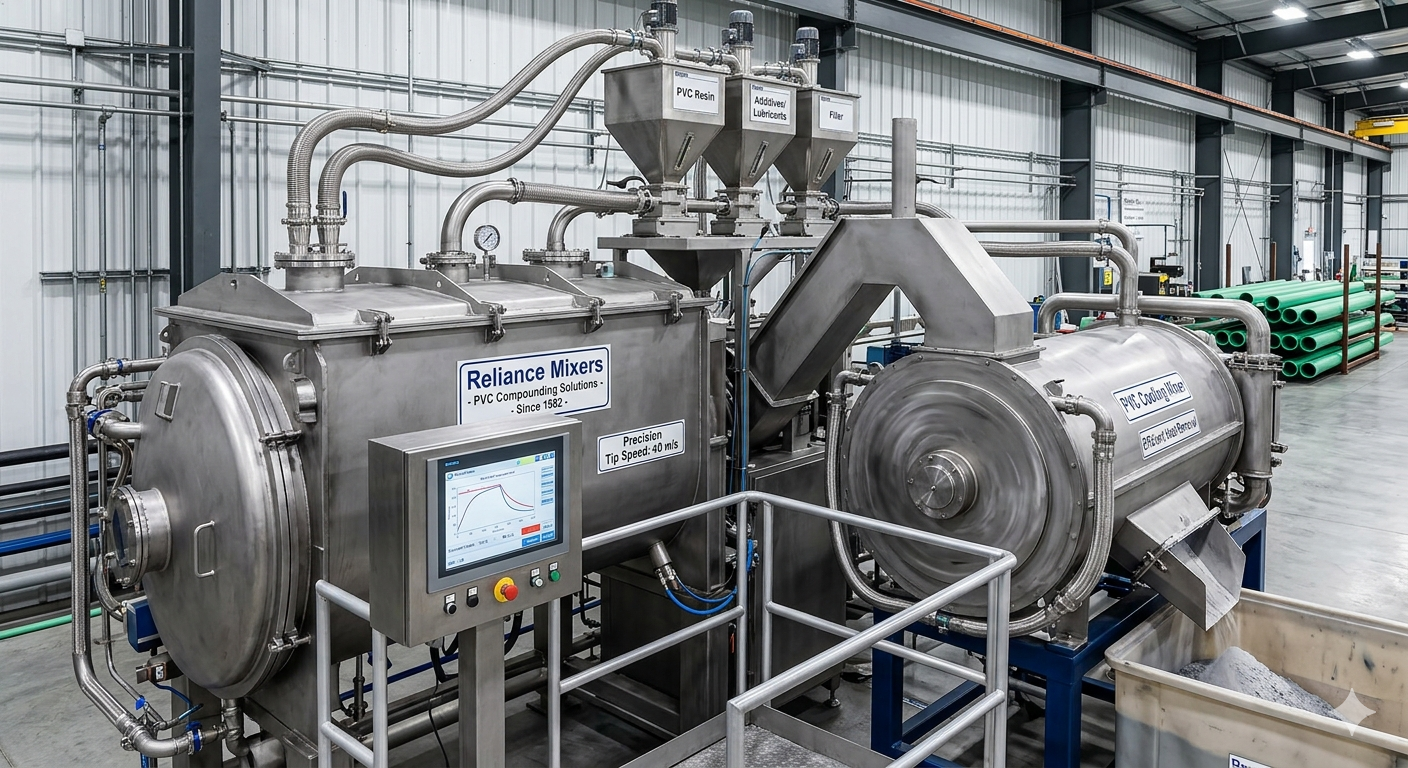
- Plastics and Color Compounding: Gentle blending of base polymers with additives, fillers, and colorants creates uniform compounds without the heat buildup that degrades PVC or affects color stability.
- Powder Coating: Preserving particle characteristics during blending maintains electrostatic charge properties essential for successful coating application. Aggressive mixing damages these properties.
- Food and Pharmaceuticals: 150-grit polished stainless steel surfaces prevent adhesion, enable fast cleaning, and support contamination-sensitive production. Paddle mixers handle free-flowing powders and granules without the shear that compromises product integrity.
- Chemicals and Specialty Materials: Controlled blending of multi-component formulations without excessive heat generation. From rubber compounding to battery materials, the gentle tumbling action provides homogeneity without triggering unwanted reactions.
The key advantage is gentle efficiency: complete batch circulation that achieves uniformity while preserving the physical properties that downstream processes depend on.
What to Look for When Selecting a High-Speed Mixer for Color Dispersion
Not every color dispersion application needs high intensity. For many pigment blends, paddle mixers provide sufficient dispersion without the capital cost and energy consumption of high-shear equipment.
Consider paddle mixers for color dispersion when:
- Pigments are pre-dispersed or easily wetted
- Base materials are heat-sensitive
- Batch sizes vary frequently
- Cleaning between colors must be fast and complete
When high intensity is necessary for difficult-to-disperse pigments or high-viscosity bases, Reliance High Intensity Mixers reach tip speeds up to 40 meters per second. But for many applications, our paddle mixers achieve the required color consistency with gentler handling and lower operational costs.
The right choice depends on your specific pigment, base material, and quality requirements. We help customers evaluate this during application review, ensuring you invest in the intensity level your process actually needs.
Ready to Solve Your Dry Blending Challenges?
If improving batch consistency, reducing material degradation, or scaling production without sacrificing quality is your priority, now is the time to evaluate a paddle mixer built specifically for your materials.
Contact Reliance Mixers at 281-499-9926 or visit Reliance Mixers to discuss your particle characteristics, production targets, and integration requirements. Our engineers will evaluate whether a standard configuration meets your needs or whether custom engineering delivers better long-term value.
The right mixing system should work for your production, not against it. Let’s build one that does.