Most plastic processing quality problems don’t start at the extruder. They start in the mixing room, where material decisions are made that downstream equipment can only partially correct. If your batches show color variation, inconsistent gelation, or surface defects that appear without an obvious cause, the mixing stage is usually where the investigation should begin.
High-intensity mixers are built around a specific process logic: generate controlled turbulence and shear to achieve particle-level dispersion within a thermal envelope that the material can tolerate, then discharge before conditions deteriorate. That sounds straightforward, but the engineering behind it matters considerably more than most procurement conversations acknowledge.
What High-Intensity Mixing Actually Does to Material
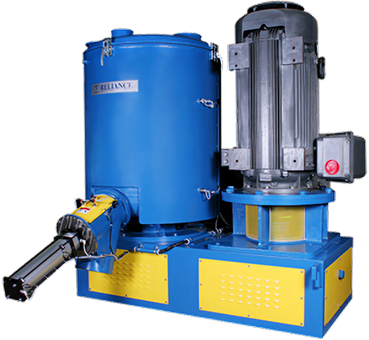
The core mechanism of a high-intensity mixer is a high-speed rotor operating inside a jacketed vessel. As rotor tip speed increases, the material in the vessel enters a turbulent state that breaks agglomerates, wets out additive surfaces, and distributes pigments or fillers at the particle level. The friction generated during this process raises the material temperature, which, in many formulations, is a useful outcome: it promotes plasticizer absorption, stabilizer distribution, and resin surface activation.
The control challenge is the same heat generation. PVC formulations begin to degrade above certain temperature thresholds. Thermosetting powder coatings crosslink irreversibly above 50-60 °C. In both cases, the mixer has to reach adequate dispersion before the thermal limit is reached, which makes cycle time and temperature monitoring inseparable variables.
This is where high-intensity plastic mixers separate themselves from general-purpose blending equipment. The rotor geometry, vessel aspect ratio, drive system, and control architecture all influence how quickly dispersion is achieved and how reliably the thermal window is respected across production conditions.
Why Customized Mixers Outperform Standard Configurations
There’s a version of this equipment decision that goes: find the largest standard unit that fits the budget and adjust the process to fit. Facilities that take that approach tend to find one or two formulations that run acceptably and a range of others requiring constant manual compensation.
The alternative is specifying the mixer around the material. Customized mixers built for a defined formulation range or application set offer several specific advantages over standard configurations:
- Rotor geometry matched to the shear requirement of the material, whether that’s aggressive dispersion of carbon black in rubber or gentle incorporation of pigment into polyethylene powder
- Drive systems sized for the torque profile the material actually presents, not a generalized estimate
- Vessel geometry configured for the fill volume range the operation runs, maintaining the shear zone efficiency at both low and high batch sizes
- Temperature management is designed for the specific thermal window of the formulation, whether that requires active cooling, heating, or a staged combination of both
- Discharge mechanisms suited to the material’s viscosity and flow behavior at discharge conditions
The performance difference between a standard unit and a purpose-configured one tends to be most visible at the edges of the production range: unusual formulations, new colorants, temperature-sensitive additives, or batches at the low end of rated capacity where shear zone geometry matters most.
Plastic Processing Applications Where Configuration Decisions Matter Most
Not all plastic processing applications place the same demands on mixing equipment. The table below summarizes where configuration specificity has the highest impact on output quality:
Application | Primary Mixing Challenge | Configuration Factor That Matters Most |
PVC dry blending | Thermal window management | Temperature-triggered discharge, staged heating |
Masterbatch and color concentrate | Pigment dispersion at low loading | Rotor tip speed, cycle profile per colorant type |
Polyethylene powder (rotomolding) | Particle-level uniformity without thermal damage | Vessel geometry, fill level, discharge design |
Powder coating pre-mix | Agglomerate breakdown within the crosslink threshold | Real-time temperature monitoring, variable frequency drive |
Rubber compounding | Filler dispersion without vulcanization trigger | Shear intensity control, curative addition sequence |
Reliance Mixers’ high-intensity mixer configurations are developed around application-specific parameters rather than adapted from a standard platform. That distinction affects both dispersion quality and cycle-to-cycle repeatability across production conditions.
Control Systems and Their Role in Process Repeatability
The mixing vessel and rotor are only part of what determines output consistency. The control system determines whether a mixer produces repeatable results or requires constant operator intervention to compensate for cycle-to-cycle variation.
A control system that triggers discharge based on elapsed time introduces a structural vulnerability: batches that heat faster than average, which happens when the vessel is warm from prior cycles, will be over-processed. Batches that heat slowly will be under-processed. Over a full production shift, that variation accumulates in the output.
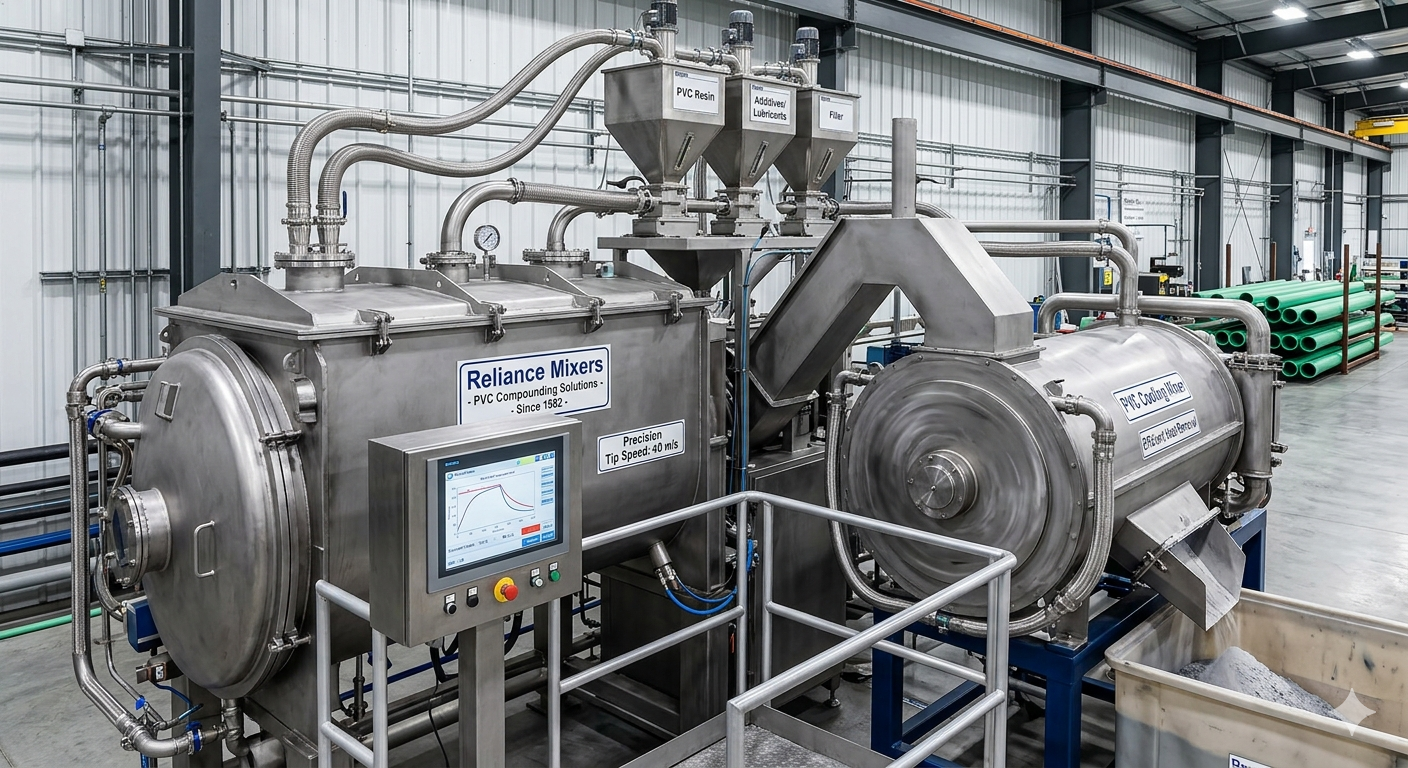
Temperature-triggered discharge eliminates this by responding to actual material condition rather than elapsed time. Combined with rotor speed logging, friction temperature profiling, and per-cycle data capture, a well-specified control system turns the mixing stage from a variable into a documented process with measurable inputs and traceable outputs.
For manufacturers running multiple formulations or producing for customers with batch-traceability requirements, this capability is a process quality requirement rather than an optional feature.
Evaluating Mixing Equipment for Your Application
Before specifying any mixing equipment for plastic processing, document the following for each formulation in your production range: target friction temperature or thermal limit, required dispersion quality metric, batch volume range, cycle time target, and downstream discharge requirements. That documentation gives the supplier the information needed to configure equipment appropriately rather than recommending the nearest standard unit.
Reliance Mixers’ high-intensity mixer product line covers the configuration range from standard PVC dry blending to custom-engineered solutions for specialty compounding applications. Reviewing the application-specific configurations available is a practical starting point for manufacturers working through equipment specifications for plastic processing.
Making the Right Mixer Decision for Your Plastic Processing Operation
Plastic processing quality is built at the mixing stage, and the equipment decisions made there follow the material through every downstream step. A mixer that’s correctly specified for your formulation range, thermal requirements, and production volume doesn’t just improve individual batches. It removes the upstream variability that makes every downstream process harder to control.
The manufacturers who get the most consistent output from their plastic processing lines aren’t necessarily running the most expensive equipment. They’re running equipment that was specified around their actual materials and production conditions rather than adapted to fit a standard configuration. That distinction is what separates a mixing system that performs reliably across a ten-year service life from one that requires constant process compensation to produce acceptable results.
If your current mixing setup produces batch-to-batch variation you can’t fully explain, cycle times that constrain throughput, or color and dispersion results that require rework or manual intervention, those are signals worth investigating at the mixing stage before looking downstream.
Reliance Mixers engineers high-intensity plastic mixers and customized mixer configurations for plastic processing applications, including PVC dry blending, masterbatch, color concentrate, and powder coating. To discuss your formulation requirements, batch volume range, and production targets with their application engineers, visit Reliance Mixers or call (281) 499-9926.