By the Process Engineering Team | Reliance Mixers | Since 1982, Reliability in Every Batch
When hot material sits too long in a cooling mixer, the compound degrades, and production schedules fall apart. If the cooling system cannot pull heat fast enough, the extruder line stops, and off-spec material accumulates.
Reliance Mixers designs cooling mixers for plastic processing that handle real production conditions. These systems perform on plant floors where cooling water runs warmer than spec sheet assumptions and previous batches run hotter than expected.
Why Cooling Speed Defines Your Throughput
The mixing cycle is rarely the bottleneck; the cooling cycle is.
A high-intensity mixer can blend PVC or other compounds in under six minutes. But when the cooling mixer needs twenty minutes to drop the temperature from 245°F to 140°F, the hot mixer sits idle. Compound transfer stops, and the extrusion line receives no material.
Reliance coolers consistently achieve sub-6-minute cooling cycles, not just occasionally and not under ideal conditions, but on every batch.
Horizontal and Vertical Cooler Discharge: Picking Your Layout
Plant geometry determines whether horizontal or vertical discharge works better. Horizontal units align with existing conveyors, while vertical drops suit gravity-fed downstream equipment.
Horizontal coolers use slide gate valves or flapper assemblies. Material moves out fast and controlled, straight into pneumatic conveying or belt systems. Vertical coolers use pneumatic discharge plugs with limit switches for position feedback. This design prevents misalignment issues that cause leakage or incomplete emptying.
Both designs feature larger discharge openings that release material quickly and shorten the overall cycle time.
How the Tools Move Material Against the Jacket
Cooling efficiency depends on how well the material contacts the jacket wall. When paddle arms fail to keep the compound moving against the cooled surface, a stagnant boundary layer forms. Heat transfer slows dramatically because conduction through still material is much less efficient than turbulent convection.
Reliance horizontal and vertical tools of cooling mixers solve this problem with deliberate mechanical action.
Horizontal coolers use dual-arm paddles bolted to the shaft. These span the full length of both arms and constantly throw material against the inner wall where the jacket is located. Vertical coolers use different geometries but achieve the same goal. They keep everything in motion so heat transfers uniformly across the batch.
Tool surfaces are finished to a high standard to resist wear. Abrasive compounds, such as calcium carbonate and certain mineral fillers, gradually erode rough finishes. This shortens service life and makes cleanup between color changes more difficult. A smooth surface lasts longer and cleans faster.
Jacket Design: Where the Cooling Actually Happens
The jacket is not simply a water channel wrapped around the bowl. It is the heart of the machine.
Reliance builds coolers with thick walls. The inside cylinder uses up to twice the steel thickness of some European competitors. This matters for both heat transfer and durability. Thin walls dent, warp, and develop leaks under thermal cycling.
Flow bars inside the jacket create turbulent water flow. Laminar flow looks efficient on paper, but turbulent flow pulls heat faster. Reliance tests its jackets to 60 psi and designs them to run at 40 psi. This higher pressure allows more water volume through when maximum cooling is needed.
Vertical coolers receive full jacket coverage on the cylinder, lid, and bottom plate. Optional cooling cones add surface area for applications that run at thermal limits. Horizontal coolers use high-pressure jackets on the cylinder and lid for rapidly cooling the product.
Cooling-Mixers for Compounding: The Integration Picture
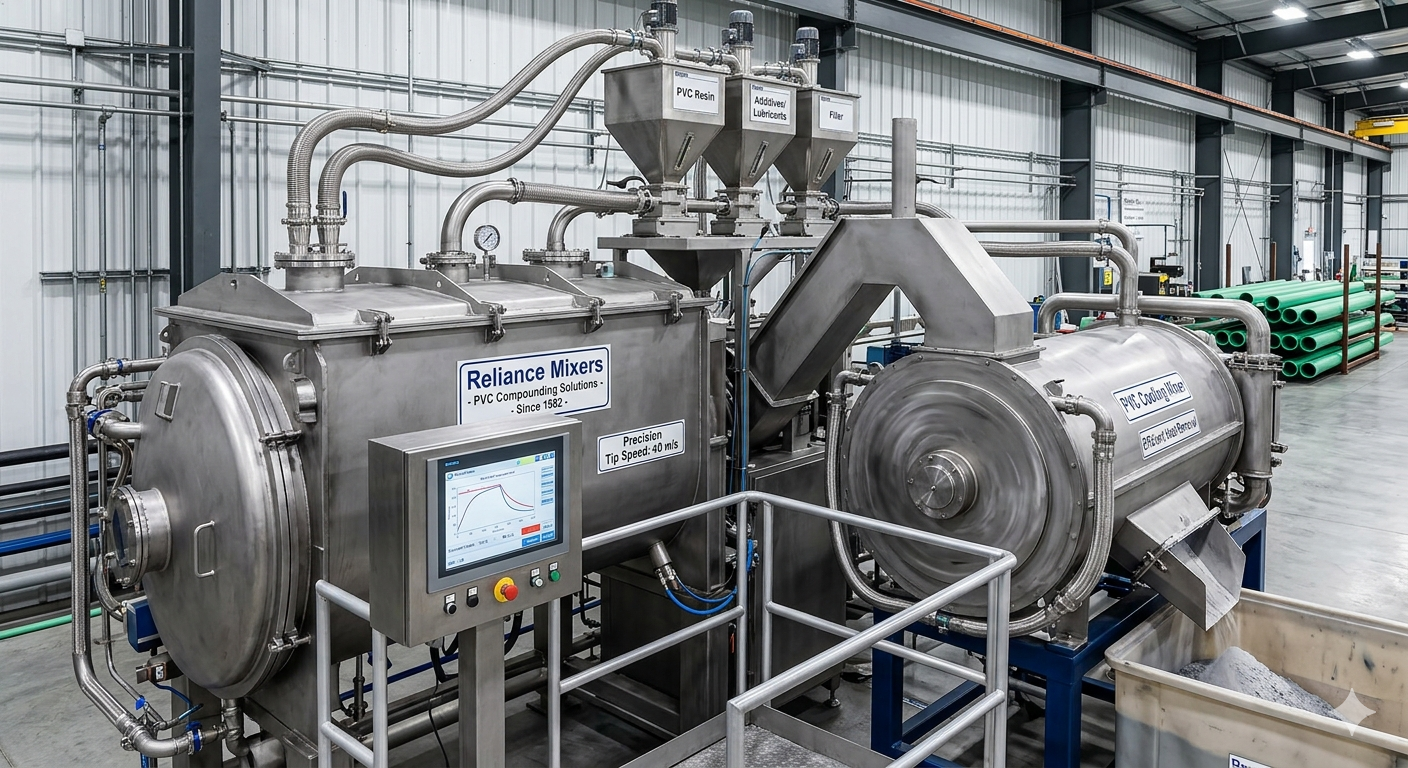
Standalone coolers miss the point. In compounding, especially PVC, the entire system matters.
Hot material discharges from the high-intensity mixer directly into the cooler at temperatures up to 245°F. The cooler must drop to below 140°F before the batch is stable enough for storage or downstream extrusion. During this phase, remaining liquid additives absorb and fuse with the resin.
Reliance cooling-mixers for compounding are designed for this handoff. Controls coordinate between the hot mixer and cooler through temperature triggers, interlocks, and sequenced discharge. The cooling mixer protects material integrity, and the control system protects process timing.
What to Evaluate When Specifying
Capacity ratings alone do not tell the full story. Consider these factors when comparing cooling mixer options:
- Actual cooling cycle time with your material at your incoming temperature.
- Jacket construction quality and whether it handles your water pressure and thermal cycling.
- Bearing and seal accessibility without major disassembly.
- Discharge size relative to your downstream rate.
- Parts availability and lead times for replacement components.
Reliance manufactures in Missouri City, Texas. Replacement components ship from domestic inventory. When a cooler goes down, every hour of lead time costs production.
Ready to Specify Your Cooling Mixer?
If the current cooling setup limits throughput or causes quality variation, the fix may be mechanical rather than operational.
View Reliance cooling mixer specifications or contact our applications team to discuss material temperatures, cycle targets, and plant layout constraints.