By the Production Engineering Team | Reliance Mixers | Since 1982, Reliability in Every Batch
Some materials just don’t cooperate. Try blending rubber compounds in equipment that has generic specs, and you’ll watch carbon black agglomerates survive the entire cycle. The dispersion stays poor, physical properties suffer, and you end up with scrap parts that fail testing.
That’s the moment you realize you need shear, a real shear. Not gentle tumbling but aggressive, high-speed mechanical force that breaks particle clusters apart and redistributes them uniformly.
We’ve been building Reliance high-intensity mixers since 1982 for exactly these situations. An automotive supplier we worked with was running 15-minute cycles in a Banbury mixer and still seeing 3.2% scrap rates. After switching to our high-intensity system, they hit 6-minute cycles and dropped scrap to 0.8%, and annual savings hit $340,000. The machine didn’t just mix better; it changed their entire economics.
The Mechanics: How These Machines Actually Work
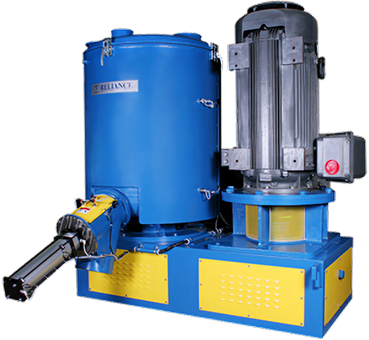
The core principle is straightforward. A high-speed rotor spins at the bottom of a fixed bowl, hitting tip speeds between 35 and 50 meters per second. At that velocity, the material fluidizes. The spinning tool creates a vortex, throwing particles outward, up the bowl walls, then back down through the center. Every particle passes through the high-shear zone repeatedly.
What separates decent machines from great ones lies in the details. Take the high-intensity mixer bowl. We build ours from SS304 as standard, with optional hard-facing on the bottom plate for abrasive materials. The geometry matters enormously: too shallow and you lose vortex depth; too steep and material cakes on walls instead of circulating. Our bowl angles evolved from years of compounder feedback, not calculations that are based on a textbook.
The high-intensity mixer tools do the actual work. We manufacture these from solid stock and apply wear-resistant coatings to the high-wear areas. Tungsten carbide or ceramic facing extends tool life when running mineral-filled compounds. The tool geometry promotes self-cleaning action in which material doesn’t accumulate on surfaces, cutting changeover time between batches.
Getting Material Out Fast: The Discharge Challenge
Here’s something that doesn’t get enough attention in the mixer selection: how quickly can you empty the bowl? A 6-minute mixing cycle loses its advantage if you’re spending 4 minutes digging material out afterward.
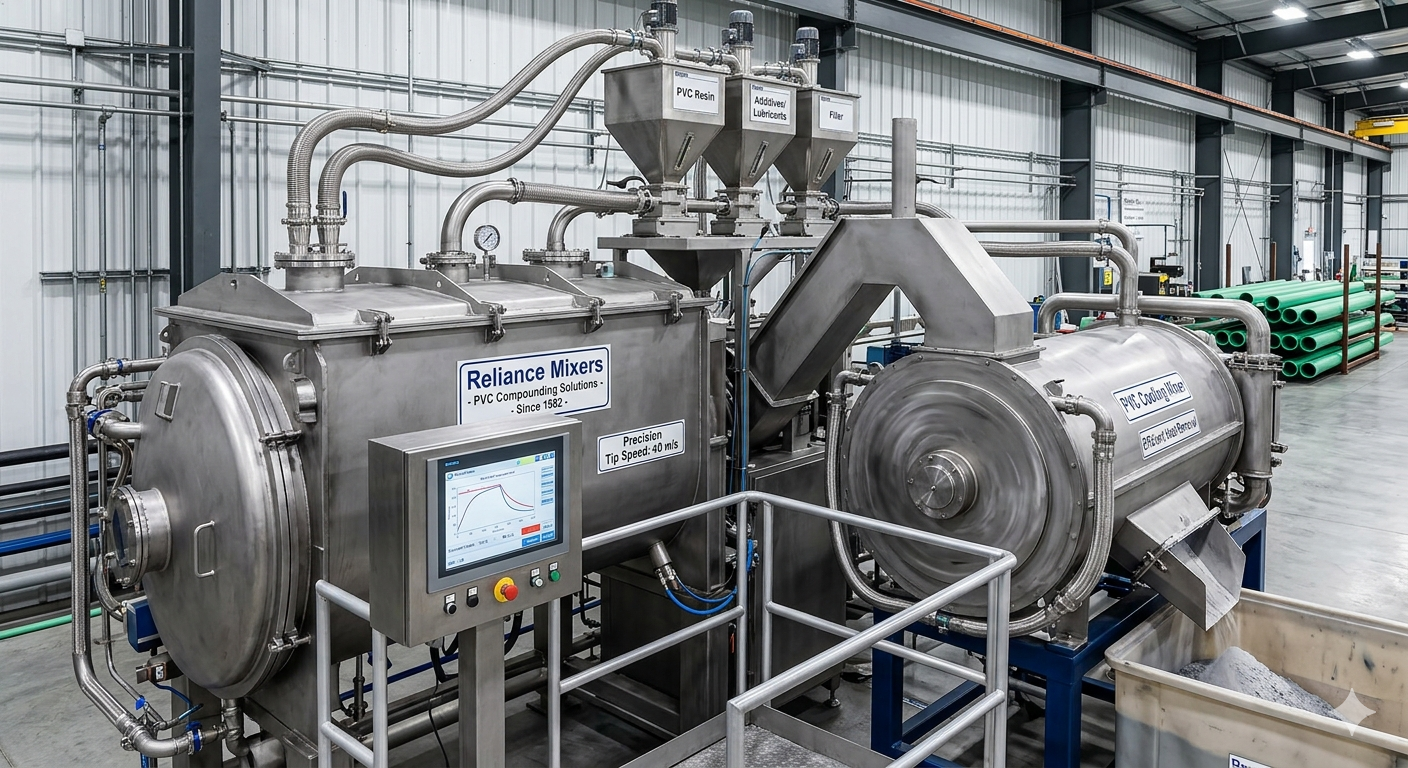
Our high-intensity mixer discharge uses large pneumatic openings, depending on your material flow characteristics. Openings are sized for rapid emptying with minimal residue. For PVC applications, this matters especially because downstream, you typically pair the hot mixer with a cooling mixer. Fast discharge keeps batch sequencing tight and prevents heat-soaked material from sitting too long.
Slow discharge becomes the bottleneck limiting daily throughput regardless of mixing speed.
Three Configurations, Different Sweet Spots
Not every operation needs the same drive setup. We offer three approaches:
Standard Drive uses a belt and gearbox reduction. It’s proven, cost-effective, and easier to service in locations where specialized motor technicians aren’t readily available. Bowl sizes from 50 to 500 liters.
Direct Drive couples the motor straight to the mixing shaft. You will lose mechanical complexity, gain energy efficiency, and hit higher tip speeds with up to 50 m/s. This is better for rubber compounding and masterbatch work where you need maximum dispersion energy. Range is 100 to 1,000 liters.
E-Series hits the value point for high-volume operations. Same mixing performance, with simplified construction, and bowl sizes up to 2,000 liters. Popular with established compounders who know exactly what they need.
When High Intensity Mixing Becomes Necessary
I get asked regularly: “Can’t I just run longer cycles in my existing equipment?” Sometimes, yes. But when you’re dealing with:
- Pigment dispersion into resin matrices
- Breaking down additive agglomerates
- PVC dry blend requiring specific gelation levels
- Masterbatch with high pigment loading
- Rubber compounds needing carbon black distribution
…then shear intensity matters more than mixing time. You can’t get there with gentle equipment, no matter how patient you are. The physics doesn’t work.
Integration with Cooling Systems
For PVC specifically, the hot mixer is only half the story. You discharge at high temperature into a cooling mixers that drops the temperature rapidly before storage or extrusion. Our controls coordinate this handoff, such as temperature triggers, interlocks, and sequenced discharge. The cooling mixer protects material integrity; the control system protects process timing.
What to Evaluate Before Buying
If you’re comparing options, look past the spec sheet. Ask:
- How long does bearing replacement actually take? Our two-piece housing design lets you service the lower bearing without removing the bowl on mid-size units.
- What’s the real lead time for wear parts? We stock domestically in Texas.
- Can the tool configuration change for different products? We offer hardened tools, different blade angles, and custom geometries.
- How responsive is the manufacturer when something goes wrong?
The machine will be in your plant for years. The relationship with the builder matters almost as much as the steel.
Ready to Specify Your Mixer?
If your current mixing setup limits product quality or throughput, moving to high-intensity equipment can deliver measurable improvements in cycle time and scrap reduction.
View Reliance high intensity mixer specifications or contact our applications team to walk through your material characteristics, batch targets, and integration requirements.